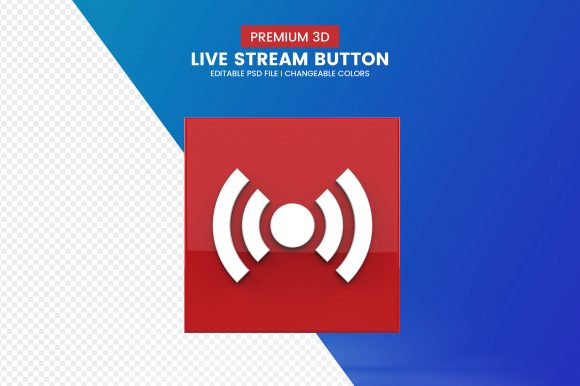
3D Live Streaming Button Ideas
The Psychology of Depth in User Interfaces
Flat design has its place, but the human eye is naturally drawn to objects that exhibit depth, shadow, and light. A 3D button mimics real-world physics—light hitting a surface, shadows casting below, edges reflecting the environment. This familiarity creates a subconscious sense of reliability and clickability. When a viewer sees a 3D live streaming button, they intuitively understand that it is an actionable element. This principle, known as an affordance, is crucial for user experience. For streamers and content creators, this translates directly to higher engagement rates. A button that looks like it can be pressed invites the action, reducing friction for first-time followers or donors.
Exploring Styles and Aesthetics for 3D Buttons
The term "3D" covers a vast spectrum of visual styles. Your choice of aesthetic should align with your brand identity and the emotional response you want to evoke. Here are several creative directions for your 3D live streaming button designs.
Holographic and Glassmorphism
This modern approach combines transparency with 3D depth. Imagine a button that looks like frosted glass, with light refracting through its edges and floating above a backdrop. This style works exceptionally well for tech-focused streams, futuristic branding, or creators who want a clean, premium look. The key is to layer your 3D live streaming button over a dynamic background so the transparency effect shines.
Isometric World-Building
Character and Mascot Integration
Animated State Changes
- Idle: Gently floating or pulsing with a subtle glow.
- Hover: The button lifts slightly, and a rim light intensifies.
- Click: The button depresses into its socket with a satisfying squash.
- Success: A burst of particles or a color shift to confirm the action.
Retro 3D with Voxel or Low-Poly Aesthetics
Practical Applications for Different Creator Profiles
For Marketers and Entrepreneurs
When hosting a product launch or a webinar, your call-to-action needs to convey authority and trust. A sleek, metallic or glass 3D button with a subtle, slow idle animation communicates stability. Avoid overly flashy animations that distract from your message. Place the button strategically near your product demo area. A polished 3D live streaming button here acts as a silent salesperson, guiding viewers toward the next step.
For Educators and Course Creators
For Freelancers and Designers
For Gamers and Hobbyists
This is where personality reigns. Let your 3D buttons reflect the culture of your community. If you run a cozy "Coffee and Code" stream, design a 3D button that looks like a steaming mug. For high-energy esports, use sharp, angular geometry with neon emissive materials. The best 3d live streaming button for gamers is one that feels like an extension of the game world itself.
Building and Implementing Your 3D Button
Choosing the Right Tools
- Spline: Excellent for real-time 3D design. It allows you to create complex materials and animations without a steep learning curve. It also supports direct export to browser sources for interactive hover effects.
- Blender: The industry standard for high-fidelity 3D. Use Blender for complex simulations, advanced shaders, and photorealistic renders. Export as PNG sequences or transparent WebM files.
- After Effects: Ideal for compositing 3D elements with 2D overlays. You can use plugins like Element 3D or integrate rendered 3D passes to add post-processing effects like glow and depth of field.
Technical Best Practices for Streaming
- File Size: Keep animated exports under 1-2 MB if possible. Use optimized compression for WebM files.
- Transparency: Always export with an alpha channel (RGBA) so the button seamlessly integrates with your overlay.
- Resolution: Avoid exporting at 4K for a small UI element. 1080p or even 720p is often sufficient, saving valuable GPU resources for your stream encoder.
- Integration: Use OBS Studio or Streamlabs. For static animations, use a Media Source. For interactive 3D buttons that respond to clicks, use a Browser Source pointing to a local HTML file.
Creating a Cohesive Set
- Lighting: All buttons should share the same light source direction to maintain spatial consistency.
- Materials: Use the same primary material (e.g., brushed metal) across all buttons, varying only the accent colors.
- Camera Angle: Keep the perspective consistent. Whether it's isometric or front-facing, uniformity creates a professional, branded look.
Avoiding Common Pitfalls
Poor Readability: A glossy 3D material can create harsh reflections that obscure text. Always test your button with the actual text on it. Consider a soft matte finish or a subtle backplate to ensure the label is legible at a glance.
Overcomplication: A spinning, glowing, particle-emitting button might look impressive, but it can overwhelm the viewer. Start with two or three states (idle, hover, click) and refine them until they feel smooth. Sometimes a gentle float and a subtle shadow shift are all you need.
Lack of Contrast: A 3D button needs to pop against your background. If your stream background is dark, use bright emissive materials or rim lighting to outline the button. If it is light, use darker shadows and rich, saturated colors. Accessibility matters here—ensure sufficient contrast for viewers with visual impairments.
Iteration and Real-World Testing
The final piece of advice is to treat your 3D streaming interface as a living project. Run a poll in your community asking which button style they prefer. Test a flat 2D button against your new 3D version for a week and compare your engagement metrics. Data-driven design decisions often reveal that a well-executed 3D live streaming button significantly outperforms standard graphics because it captures attention without demanding it. Refine your workflow, experiment with new materials, and enjoy the process of bringing a tactile, dimensional quality to your digital space.