How 3D Sphere Circle Halftone Pattern Design Is Redefining Visual Depth and Texture
Design trends are always shifting, but some techniques manage to bridge the gap between retro aesthetics and modern digital needs. The 3D Sphere Circle Halftone Pattern Design is one of those rare visual approaches. It combines the illusion of roundness, the rhythm of repeated circles, and the gradient-like effect of halftone dots to create something that feels both tactile and futuristic. Whether you are working on a poster, a web interface, or a brand identity, understanding how this pattern works and where it fits can give your projects a distinctive edge.
What Makes This Pattern Unique
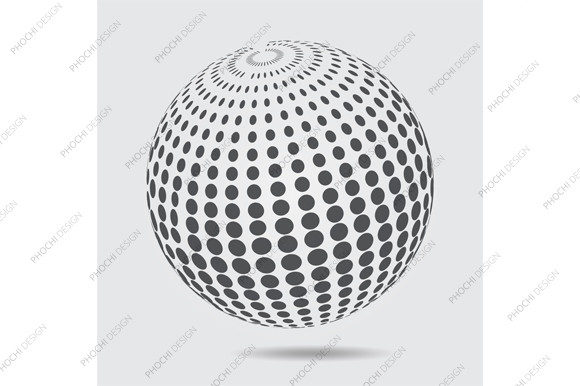
At first glance, a 3D Sphere Circle Halftone Pattern Design looks like a sphere rendered through dots. But dig deeper, and you will notice that it is not a simple gradient or a standard 3D render. The pattern is built from concentric or staggered circles that vary in size, density, or spacing to simulate depth. The halftone effect comes into play when these circles shrink or expand in a way that mimics shading—smaller dots near the highlight, larger dots toward the shadow.
This technique borrows from traditional print halftoning, where dots create the illusion of continuous tone. But when you add a spherical structure and organize those dots into circles, the result becomes something else entirely. You get a hybrid that is part geometric pattern, part optical illusion, and part texture. It works equally well in flat graphics, motion design, and even physical applications like screen printing or laser engraving.
The Role of Circle Halftone in Creating Depth
One of the most interesting qualities of a 3D Sphere Circle Halftone Pattern Design is how it uses the circle halftone itself to suggest volume. Unlike a standard radial gradient, which blends smoothly from light to dark, this pattern relies on discrete circular elements. The brain interprets the varying sizes of these circles as changes in light and shadow. A large cluster of dense circles reads as a dark area, while sparse, tiny circles read as a highlight. When these circles are arranged in a spherical layout, the mind automatically constructs a three-dimensional form.
This makes the pattern particularly effective for minimalist or monochromatic designs. Even with just two colors, you can achieve a surprising amount of depth. Designers often use black and white, but the effect also works with metallic inks, neon tones, or subtle tints. The key is maintaining the relationship between dot size and perceived curvature.
Where 3D Sphere Circle Halftone Pattern Design Shines in Modern Workflows
Modern design tools like Adobe Illustrator, CorelDRAW, or even procedural tools like Processing and Houdini make it relatively easy to generate this pattern programmatically. But the real challenge is not the technical execution—it is knowing when and why to use it. Here are a few scenarios where the 3D Sphere Circle Halftone Pattern Design adds genuine value.
Brand Identity and Logo Systems
Brands that want to communicate precision, technology, or craftsmanship often look for patterns that are both structured and organic. A sphere built from circles feels engineered, but the halftone effect keeps it from looking too rigid. It can serve as a secondary logo element, a watermark, or a repeating background texture. For example, a tech startup focusing on optics or data visualization might use a 3D Sphere Circle Halftone Pattern Design to suggest clarity and layered thinking. A craft brewery might use it on labels to evoke retro print techniques while still looking contemporary.
The pattern also scales well. At small sizes, it reads as a textured sphere. At large sizes, the individual circles become visible, creating a striking macro effect. This versatility is rare in decorative patterns, and it makes the design suitable for everything from business cards to billboards.
Packaging and Print Projects
In print, halftone patterns have a long history, but applying them to a spherical form adds a twist. Packaging designers increasingly look for ways to make products stand out on crowded shelves, and a 3D Sphere Circle Halftone Pattern Design can create a tactile, almost lenticular feel without the cost of special printing processes. When printed with a spot varnish or embossing, the raised circles reinforce the spherical illusion physically. You can achieve this effect with offset printing, screen printing, or even digital print on textured stock.
For packaging, the pattern works particularly well on cylindrical or spherical containers. A coffee tin, a cosmetic jar, or a beverage can wrapped in a sphere-inspired halftone pattern creates a natural visual continuity between the graphic and the object's shape.
Practical Benefits and Considerations
Before adopting a 3D Sphere Circle Halftone Pattern Design in your own work, it is worth weighing a few practical factors. This pattern is not a one-size-fits-all solution. It demands intentionality in color choice, scale, and application.
Color and Contrast
The pattern relies heavily on contrast to convey depth. If the colors are too close in value, the spherical illusion collapses, and you are left with a flat scattering of circles. Dark backgrounds with bright highlights or light backgrounds with dense shadows tend to work best. High contrast is your friend here. However, that does not mean you are limited to black and white. A deep navy sphere with bright cyan dots produces a sleek, digital look. A warm terracotta sphere with cream dots feels more organic. The halftone effect is flexible, but the relationship between the two colors matters more than the specific hues.
Scale and Viewing Distance
Another consideration is how the pattern will be viewed. A 3D Sphere Circle Halftone Pattern Design intended for a large poster will need larger circles and wider spacing to remain legible from a distance. On a smartphone screen, the same pattern might need much finer dots to avoid looking chunkier than intended. Always test the pattern at the actual viewing size and distance. This is where vector-based generation is particularly helpful—you can adjust the dot size and density without rebuilding the entire design.
If you are working in motion graphics, consider how the pattern behaves when scaled or rotated. Because the circles are arranged in a spherical layout, rotating the entire pattern can cause the highlight to move, creating a subtle parallax effect. This can be intentional, but it requires careful timing to avoid disorienting the viewer.
File Size and Performance
Depending on how you generate the pattern, file size can become an issue. A dense 3D Sphere Circle Halftone Pattern Design with hundreds or thousands of individual circles can bloat SVG files or slow down rendering in real-time applications. If you are using the pattern on a website or in a mobile interface, consider using a CSS gradient with a repeating radial pattern as a lightweight alternative. For print, vector outlines are fine, but rasterizing the pattern at high resolution might be more practical for complex variations.
Common Approaches to Creating the Pattern
There is no single correct way to build a 3D Sphere Circle Halftone Pattern Design, but most methods fall into one of three categories.
The first is manual placement, where you arrange circles by hand or using polar grid tools. This gives you total control over the shading and dot distribution, but it is time-consuming and works best for small, iconic uses.
The second approach uses vector halftone plugins or scripts within design software. These tools let you apply a halftone effect to a spherical gradient, then convert the result into individual circles. This is the most common workflow for professional designers because it offers speed and repeatability. You can adjust the frequency, angle, and dot shape to match your specific needs.
The third approach is procedural generation, using code or node-based tools. This is ideal when you need parametric control or want to animate the pattern. You can define rules for how circle size changes based on distance from the center, or how density shifts along the surface. This method is more technical but allows for the most flexibility.
Why Designers Keep Returning to This Pattern
There is something inherently satisfying about a 3D Sphere Circle Halftone Pattern Design. It manages to be both systematic and organic. The circles impose order, while the spherical shading introduces a natural, almost biological quality. In an era where digital design often strives for hyper-realism, this pattern offers a refreshing middle ground—a stylized representation of depth that does not pretend to be real.
It also ages well. Halftone techniques have been around for over a century, and the spherical motif is timeless. By combining the two, you get a design that feels nostalgic without being retro, and futuristic without being cold. That balance is difficult to achieve with other pattern styles.
Final Thoughts on Using This Design in Your Work
If you are exploring the 3D Sphere Circle Halftone Pattern Design for an upcoming project, start with a clear understanding of what you want the pattern to communicate. Is it texture? Depth? Movement? Once you know the intent, choose your color palette and scale accordingly. Test the pattern in context, and do not be afraid to iterate on the dot distribution until the spherical illusion reads clearly.
This pattern is not just a decorative afterthought. When used deliberately, it becomes a structural element that anchors the composition and guides the viewer's eye. Whether you are designing a logo, a poster, a package, or a digital interface, the 3D Sphere Circle Halftone Pattern Design offers a unique way to add visual weight and sophistication without overcrowding the layout. It is a technique worth mastering, and one that will continue to feel relevant as design trends evolve.